Sight reading app for Android with MIDI, both hands and no subscription
 By Leonard Guelmino · Updated November 2026
To learn to read music on a digital piano, look for an app that reads your playing over MIDI, by USB cable or Bluetooth, key by key. Also check whether it checks both hands on the grand staff, whether it needs a subscription and whether it works offline. On Android there are big learning apps with songs and a subscription, and small trainers just for reading; which one fits depends on whether you want to learn pieces or practise reading itself.
Full disclosure: I built Stavewise, an app for learning to read music on a digital piano. The criteria here apply to any app; Stavewise only comes at the end.
MIDI: the app reads every key
Over MIDI, a digital piano tells an app which key you press and when. Android supports this since Android 6.0, over USB and over Bluetooth LE. Many apps listen through the microphone instead, which also works on an acoustic piano. On a digital piano I practise with MIDI, because the app then gets every key reported directly instead of picking it out of the sound.
Check both ways in: not every app supports Bluetooth MIDI on Android. Simply Piano, for example, names Bluetooth MIDI in its help only for iPhone and iPad. If your piano has no Bluetooth, you need a cable anyway.
Both hands on the grand staff
Piano music is written on two staves, usually treble clef on top and bass clef below. The note trainer I used before showed one note after another in a single clef. That helps at first, but at the piano you read both staves at once, and often two notes sit one above the other.
So check whether the app shows both staves together and checks that both keys are down. In store listings this is usually called “both hands” or “two-hand”.
Subscription or one-time purchase
The big learning apps sell their full range as a subscription, some with a free trial week. There are also apps you buy once, and free ones. For reading itself you don’t need a song library, you need lots of new, short exercises. Try the free tier before you commit.
The “In-app purchases” label in the Play Store doesn’t tell you whether it’s a subscription. The app’s description does.
Offline and without an account
For five minutes at the piano it’s nice when an app starts without a login and without internet. Whether it needs an account or sends data to the cloud isn’t in every store listing; if in doubt, read the privacy policy, or start the app once in airplane mode.
Apps worth a look
Play listings as of 29 October 2026. The details come from the descriptions in Google Play and the makers’ help pages, not from my own tests.
Learning apps with songs and courses:
- Simply Piano: listens through the microphone or over MIDI and takes you from reading sheet music to playing with both hands; the full range is a subscription.
- flowkey: songs and courses, including reading sheet music; Wait Mode follows you through the microphone or over Bluetooth and MIDI, and you can practise each hand on its own; subscription. For Bluetooth MIDI on Android, flowkey may need the location permission, says its help.
- Skoove: lessons and songs with note reading; digital pianos over USB MIDI, Bluetooth MIDI or the microphone; Premium is a subscription.
- Synthesia: songs as sheet music or falling blocks, each hand separately or together, with a digital piano; you unlock it with a one-time purchase, no subscription. Its last update in the Play Store is from February 2025.
Trainers just for reading music:
- Complete Music Reading Trainer: drills for all seven clefs, with input over MIDI or the microphone as well; the first chapter of each clef is free, the full version a one-time purchase. The listing doesn’t mention both hands or chords.
- Piano Trainer: Sight-Reading: generates fresh exercises and checks chords and both hands together; needs a MIDI keyboard on a USB cable and doesn’t listen through the microphone; no accounts, ads or subscriptions, says the listing. The listing doesn’t mention Bluetooth MIDI.
- Note Sight: note reading and ear training, with a two-hand mode and chords; input over MIDI, the microphone or an on-screen keyboard; the Play listing shows no in-app purchases.
And Stavewise?
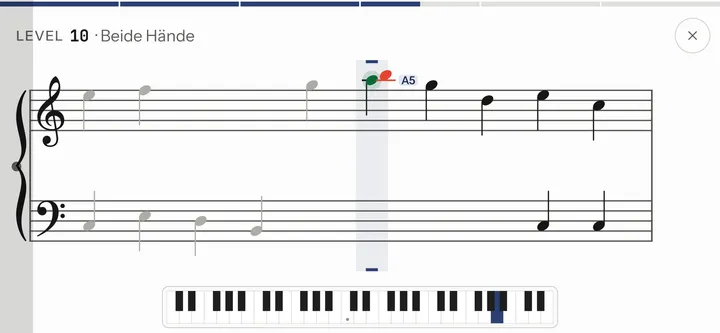
Stavewise is a trainer for reading music: it shows short melodies on the grand staff, you play them with both hands on your digital piano, and it checks every key over USB or Bluetooth MIDI; it pairs the piano itself. It works offline and without an account, on Android 12 and later. On price: Levels 1 to 9 are free, you buy the full version once in Google Play, no subscription.
What it can’t do: it doesn’t listen through the microphone, so an acoustic piano won’t work. There are no songs and no iPhone version, and the beta test is still running. The screenshot shows an exercise at the level “Both hands”.
Questions
Is there a sight-reading app for Android without a subscription?
Yes. Of the apps above, Synthesia and Complete Music Reading Trainer sell the full version once, Piano Trainer: Sight-Reading says it has no subscriptions, and Note Sight shows no in-app purchases in its Play listing (as of 29 October 2026).
Is the microphone enough instead of MIDI?
On an acoustic piano the microphone is the only way, and many apps can do it. On a digital piano I use MIDI, because the app then gets every key reported directly.
Song app or reading trainer?
If you want to play particular pieces, a song app is the obvious choice. If, like me, reading itself is what holds you back, I’d practise it separately from pieces: a piece I already know I play partly from memory, so it hardly trains my reading.
Learn to read music by playing it
Stavewise trains sight-reading on your own digital piano: short melodies with both hands, on Android, over USB or Bluetooth MIDI. The beta test is running now.
More about the app: Stavewise →