How to read treble and bass clef at the same time reading piano music with both hands
 By Leonard Guelmino · Updated November 2026
Piano music is written on two staves, one above the other: usually treble clef on top for the right hand, bass clef below for the left. Notes that sound together are lined up vertically, so at those points you read top and bottom as one. What helped me was reading each clef on its own first, then switching between the staves note by note, and only then playing two notes at once.
Full disclosure: I built Stavewise, an app for learning to read music on a digital piano. You can practise everything here with any sheet music.
Two staves, one brace
Piano music is written on two five-line staves joined by a brace on the left; together they are called the grand staff. The upper staff is normally played with the right hand and the lower staff with the left. The upper one usually has a treble clef, the lower one a bass clef.
For reading with both hands, one rule matters most: notes that sound at the same time are written directly above each other. Between the staves sits middle C, on a ledger line below the upper staff or above the lower one.
Read down, not line by line
It is tempting to read the two staves like two lines of text: a bit of the top, then the bottom. That does not work at the piano, because the hands play at the same time. What helped me was seeing a spot with two notes as one picture: where is the lower note, where is the upper one, then both keys together.
When only one hand plays, I only look at its staff. What mattered for me was not hunting for the staff the next note is in, but keeping both staves in view.
The order I practised in
- Each clef on its own, with only a few notes. I practised bass clef in its own right instead of translating it from treble clef.
- Switching between the staves, one note at a time, close to middle C at first. C4 to G4 on top, E3 to C4 below: that keeps both hands close together.
- Widening the range bit by bit, first to the two Cs an octave above and below middle C, then further.
- Two notes at once, one per staff: a melody on top, a bass note below.
- Only then intervals and chords in one hand.
Reading ahead
Good sight-readers read ahead while they play: highly skilled musicians tend to look ahead further in the music, the so-called eye–hand span, and they recognise frequent patterns of notes as a single unit rather than as individual notes.
I am not there yet. I try to have my eyes on the next spot while I press a key, and I would rather take more time for it.
Learning to read music as an adult
I played piano for five years as a child and came back to it as an adult in 2025. Reading music was what held me back: I counted notes line by line instead of recognising them. With two staves at once, that shows even more.
So I practise reading separately from pieces. A piece I already know I play partly from memory, so it hardly trains my reading. For sight-reading this is explicit: a practice piece can only be used once, so you keep needing new music at the right level.
Being an adult had one advantage: I knew where I got stuck and could practise exactly that, instead of working through a method book from front to back.
How I practise both hands
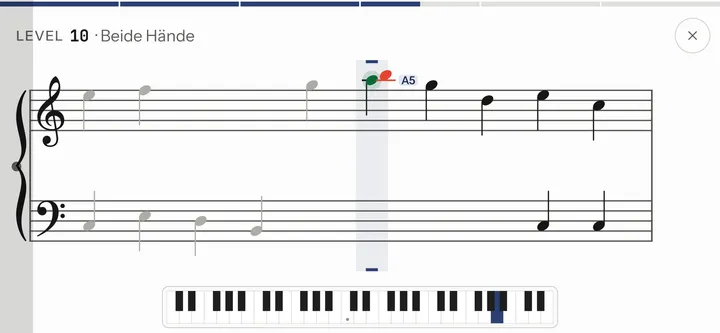
I practise at the digital piano: the app shows short melodies on the grand staff, I play them note by note, and it checks every key over MIDI. Where both hands play, it waits until both keys are down. The screenshot shows an exercise in Stavewise at the level “Both hands”: the melody on top, the bass below.
Questions
Should I practise each hand separately first?
For reading, it helped me to read each clef securely on its own first. I did not wait until one was perfect, though: I practised both in turns and started switching between the staves early.
Does the left hand always play what is in bass clef?
Not always. The lower staff is normally played with the left hand. For learning to read, the simple rule is enough for me: bottom left, top right.
Is it too late to learn to read music as an adult?
I can only speak for myself: I came back to it as an adult and have practised reading on purpose ever since. How fast it goes depends on how often you practise and what you already know; I can’t honestly give you a deadline.
Learn to read music by playing it
Stavewise trains sight-reading on your own digital piano: short melodies with both hands, on Android, over USB or Bluetooth MIDI. The beta test is running now.
More about the app: Stavewise →