How to read bass clef on piano notes for the left hand
 By Leonard Guelmino · Updated November 2026
The bass clef puts the F below middle C on the fourth line from the bottom, right between its two dots. You read everything else from there: the lines are G, B, D, F, A from the bottom up, the spaces A, C, E, G. Instead of translating from treble clef, I practise the bass clef on its own, with a small range and a few fixed landmark notes such as F and C.
Full disclosure: I built Stavewise, an app for learning to read music on a digital piano. You can practise everything here with any sheet music.
What the bass clef tells you
Piano music is written on two staves, one above the other; together they are called the grand staff. The upper staff is normally played with the right hand and the lower staff with the left. The upper one usually has a treble clef, the lower one a bass clef.
The bass clef is an F clef. Its two dots sit either side of the fourth line from the bottom, and that line is the F below middle C (F3). Middle C itself sits on the first ledger line above the staff, between the bass and the treble staff.
Lines and spaces
- The five lines, bottom to top: G, B, D, F, A.
- The four spaces, bottom to top: A, C, E, G.
The usual mnemonics are “Good Boys Do Fine Always” for the lines and “All Cows Eat Grass” for the spaces (All About Music Theory). They help when you count. When you play, though, you want to see the note and know it, not recite a sentence first.
Don’t translate from treble clef
If you learned treble clef first, it is tempting to read bass clef as a shifted treble clef and translate every note. People ask about it in piano forums, for example in “Bass Clef Strategy for Treble-Clef Dominant Reader”. Translating costs a moment on every note, and the left hand falls behind.
What helped me was practising the bass clef on its own, with exercises in that clef only, instead of working it out from treble clef. I did not have to wait until treble clef was solid for that: I practised the two clefs in turns and widened the range bit by bit.
A few landmark notes, read the rest from there
What helped me were landmark notes: a few notes I recognise at a glance and read their neighbours from, rather than learning every line at once. In bass clef, these are the landmarks I use:
- Middle C (C4): the first ledger line above the staff. You probably know it from treble clef already.
- F below middle C (F3): the line between the two dots.
- C an octave lower (C3): the second space from the bottom.
- F an octave lower (F2): the space below the bottom line.
- Low C, two octaves below middle C (C2): the second ledger line below the staff.
All five at once was too much for me. I started with a small stretch, from E3 up to middle C, with F3 as the landmark. After that I went down to C3, and only then down to C2.
Ledger lines in bass clef
Notes above or below the five lines go on short ledger lines. Going up, the first ledger line is middle C. In treble clef the same note sits on the first ledger line below the staff: middle C is the same key in both clefs, it is just written at the top of one staff or the bottom of the other.
Going down, you follow the lines: below the bottom-line G comes F in the space, then E on the first ledger line, D below it and C on the second ledger line.
How I practise bass clef
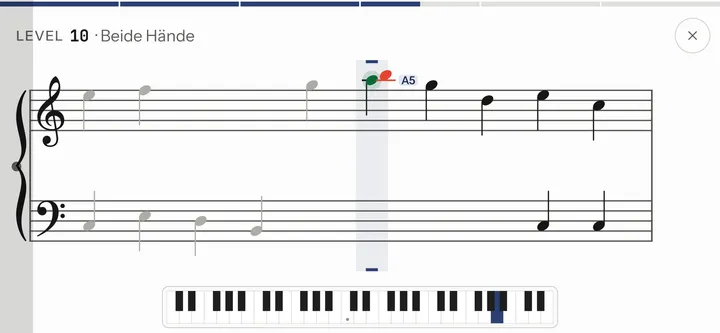
I practise at the digital piano, not on paper: the app shows short melodies, I play them note by note, and it checks every key over MIDI. Every note is a quarter note with no rhythm, so it is only about reading. The screenshot shows an exercise in Stavewise with both clefs; the lower staff is the left hand.
Questions
Do I need to know treble clef first?
Not necessarily. Both clefs follow the same rules; the notes just sit on different lines. I practised both clefs in turns from the start.
Why is middle C sometimes at the top and sometimes at the bottom?
It sits between the two staves and can be written on a ledger line below the upper staff or above the lower one. On the piano it is the same key either way.
How long until I can read bass clef fluently?
I can’t honestly tell you; it depends on how often you practise and what you already know. What I find more useful than a deadline is noticing which notes still slow me down and practising exactly those more often.
Learn to read music by playing it
Stavewise trains sight-reading on your own digital piano: short melodies with both hands, on Android, over USB or Bluetooth MIDI. The beta test is running now.
More about the app: Stavewise →